Memory Wall Decoding one token from a 7B model means streaming every weight out of RAM. That is the wall. This measures how close a real stack gets to it on a 24 GB Apple M4 Pro — a reproducible benchmark suite, a speculative decoder written from scratch in MLX, and a roofline model that had to be corrected twice before it stopped lying.
Headline results
What this is
Not an app. An engineering study of where inference time actually goes on consumer Apple Silicon, built around three things: a benchmark harness strict enough to trust, a from-scratch implementation of speculative decoding that is provably output-identical to the model it accelerates, and a written account of every place the measurements disagreed with the theory.
The methodology is the point. Every number carries a mean and a standard deviation over at least five repetitions; every CSV row carries the git commit, the model revision, the thermal state and the power source that produced it; the harness refuses to record a measurement taken on battery. Numbers that could not be measured honestly are reported as not measured, not estimated.
The roofline, corrected
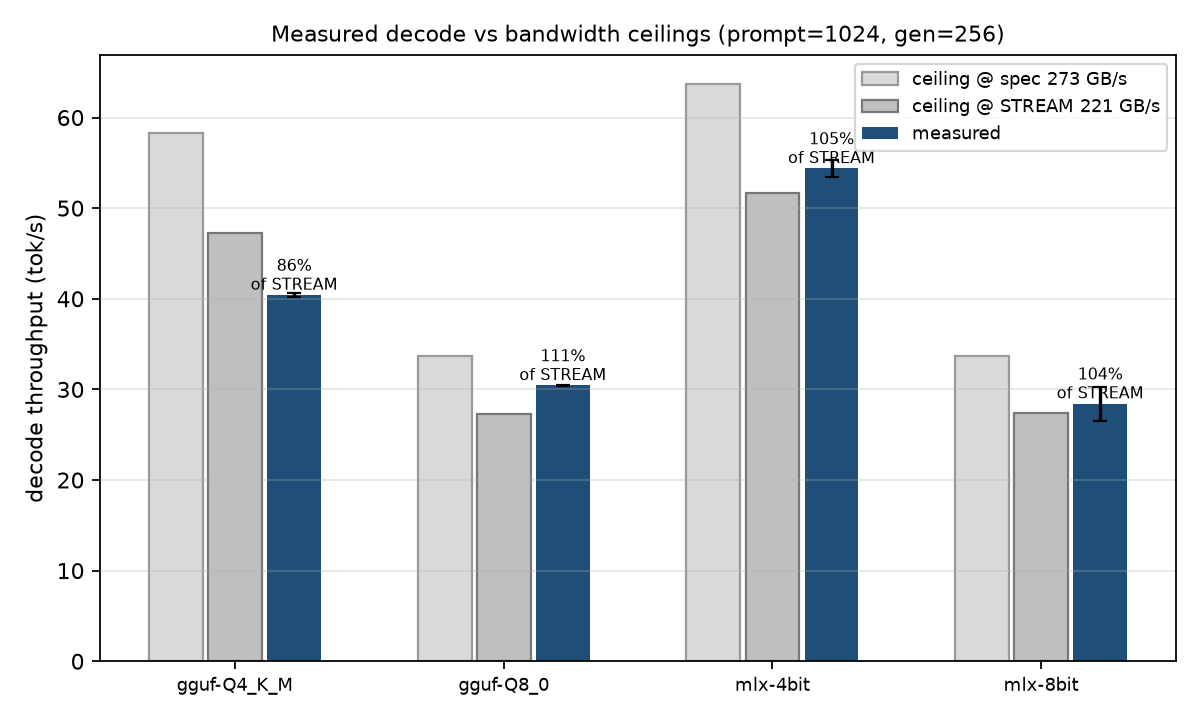
Decode is memory-bandwidth-bound: every token streams the entire weight matrix
from RAM to produce one output. The ceiling is therefore
bandwidth ÷ bytes-read-per-token — but getting bytes-read-per-token
right took two corrections.
embed_tokens never
crosses the bus during decode. Excluding it moved the arms from an apparent
>100% of roofline to the table below.| arm | total weights | embed (gathered) | streamed / token | ceiling tok/s | measured | achieved |
|---|---|---|---|---|---|---|
| mlx-8bit | 8.09 GB | 0.58 GB | 7.51 GB | 34.6 | 28.43 | 82.1% |
| mlx-4bit | 4.28 GB | 0.31 GB | 3.98 GB | 64.9 | 54.39 | 83.7% |
| gguf-Q8_0 | 8.09 GB | 0.58 GB | 7.51 GB | 34.6 | 30.44 | 87.9% |
| gguf-Q4_K_M | 4.68 GB | 0.31 GB | 4.37 GB | 59.2 | 40.42 | 68.3% |
The KV cache formula, verified exactly
kv_bytes = 2 × layers × kv_heads × head_dim × ctx × bytes_per_elt × batch
Predicted 57,344 bytes/token; measured 57,344 — a ratio of 1.000. The instructive part is the measurement that failed: inferring cache size from peak process memory overstates it by 2.5×, because peak memory during prefill also contains activation buffers that scale with prompt length. The obvious measurement was wrong; the direct one was right.
Quantization frontier
| arm | weights | decode tok/s | perplexity | task accuracy |
|---|---|---|---|---|
| mlx-8bit | 8.09 GB | 28.43 | 6.381 | 84% |
| mlx-4bit | 4.28 GB | 54.39 | 6.968 | 78% |
| gguf-Q8_0 | 8.10 GB | 30.44 | 6.373 | 82% |
| gguf-Q4_K_M | 4.68 GB | 40.42 | 6.524 | 82% |
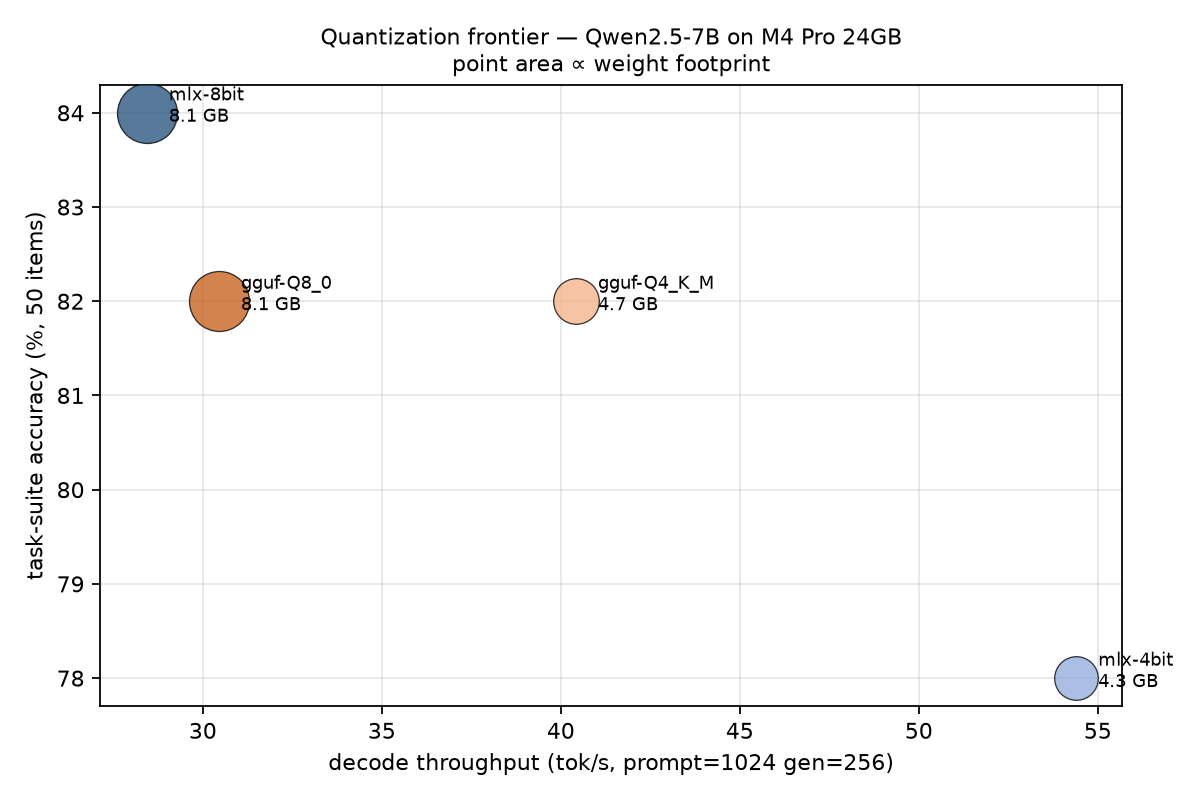
Perplexity is measured on a fixed wikitext-2 slice and is comparable across these arms only because all of them share a byte-identical Qwen2.5 tokenizer. The task suite is 50 items (GSM8K, ARC-Easy, MMLU, executed code) — enough to catch gross degradation, not enough to separate adjacent precisions. That limitation is stated rather than papered over.
Speculative decoding, from scratch
A 0.5B draft proposes k tokens; the 7B target verifies all
k+1 positions in a single forward pass. Each proposal is accepted with
probability min(1, p_target(x)/p_draft(x)); on rejection, a replacement is
drawn from the normalized residual max(0, p_target − p_draft). The emitted
distribution is then exactly the target's — the draft affects speed only,
never output. A bad draft makes it slow; it cannot make it wrong.
not measured
Acceptance depends on how predictable the next token is. Structured JSON is schema-constrained, so a small model agrees with a large one often. Prose is open-ended, the target's distribution is flat, and agreement collapses. Code sits between: syntax is constrained, identifiers are not.
Prefix cache reuse
Serving
A FastAPI server with SSE streaming and a FIFO admission queue, executing strictly sequentially. Continuous batching was not built — doing it correctly needs per-sequence caches inside a batched attention call plus padding-aware masks, and a half-working batcher would produce numbers that could not be defended. The batching effect is measured separately and cleanly instead.
not measured
Architecture
├── bench/ METHODOLOGY.md · harness.py · run_one_{mlx,llamacpp}.py
│ stream_bench.py · kv_measure.py · roofline_calc.py
│ perplexity.py · eval_quality.py · batching_bench.py
├── spec/ speculative.py · correctness_gate.py · experiments.py
│ padding_mass.py · prefix_cache.py
├── serve/ server.py (SSE + queue) · loadtest.py
├── prompts/ frozen sets, exact post-template token counts
├── docs/ roofline · quantization · speculative · serving · report
└── results/ CSV + JSON, every row carrying full provenance
make all regenerates every table, plot and document in this page from
scratch. No number in any document was typed by hand.
Honest limitations
- One machine. A single M4 Pro on one macOS build. Nothing here generalizes to other hardware, and the llama.cpp arm lacks the Metal tensor kernels that newer chips receive — so these are not "llama.cpp on Apple Silicon" numbers generally.
- fp16 unmeasurable. The 24 GB ceiling made the fp16 baseline swap-bound, so the quantization comparison has no full-precision anchor on this machine.
- 50-item eval. Wide confidence intervals; it detects gross damage, not subtle capability loss. A rigorous version needs full MMLU, GSM8K, HumanEval through lm-evaluation-harness with multiple seeds.
- Speculative decoding is batch-size-one and uses a single linear draft chain. Tree-based speculation, Medusa and EAGLE-style approaches are named as future work, not implemented.
- No continuous batching. Stated as a design decision with its reasoning, not disguised as a feature.